Industrial Demand in the Data Center Economy
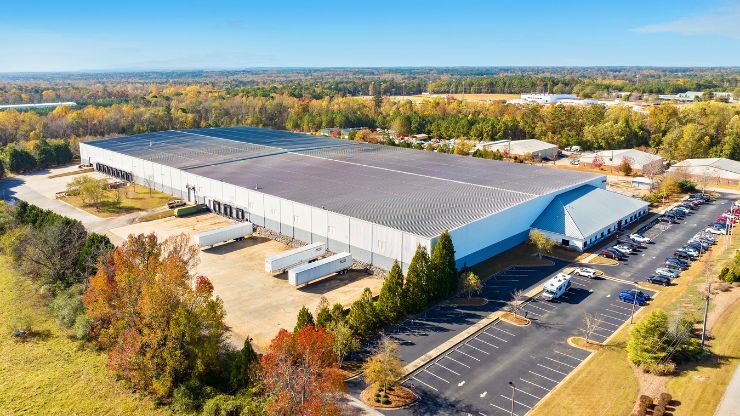
The expansion of AI, cloud computing and data driven technologies is often described as a software story. However, the digital economy depends on a vast physical ecosystem. Power generation, fiber networks and data centers are its visible components - but the industrial real estate that keeps them running is just as critical.
This “infrastructure behind the infrastructure” is now a primary driver of industrial demand: a durable, forward‑looking growth opportunity that complements - and in some cases outperforms - traditional industrial use cases tied to e‑commerce, logistics and manufacturing.
The short version for investors: industrial assets adjacent to data center corridors are showing stronger fundamentals, stickier tenants and longer economic lives than the broader market - and they capture that upside without ever becoming data centers themselves.
A new layer of industrial demand
Industrial real estate has always been cyclical, tracking consumer spending, inventory cycles and global trade flows. Those fundamentals still hold, but digital infrastructure introduces a structurally different demand dynamic.
Last year, 146 U.S. warehouse leases larger than 500,000 square feet were signed, a 31% year‑over‑year increase and the highest activity level since 2022, per Cushman & Wakefield. That activity spans multiple tenant categories, but a growing share is tied (directly or indirectly) to data center development.
Why proximity drives value
Proximity is critical: the closer a support tenant sits to the data centers it serves, the faster it can respond, the more reliably it can operate and the less it spends getting there.
Industrial assets within a five to ten‑mile radius of data centers consistently show stronger fundamentals than the broader market, particularly in established hubs such as Northern Virginia and Phoenix. In these corridors, leasing activity has accelerated as vendors compete for adjacency, often paying rental premiums to reduce travel time and operational risk.
That dynamic is already visible within ILPT’s portfolio,* where a company supporting the Atlanta data center supply chain recently signed a long-term lease on a previously vacant 200,000+ square foot facility. The tenant will never house a server. However, its need for well-located, functional space is exactly how data center capital spending spills into the industrial market. The advantage compounds: as data centers add capacity, the surrounding industrial ecosystem grows with them, reinforcing occupancy and rent growth.
*RMR manages industrial properties on behalf of Industrial Logistics Properties Trust (Nasdaq: ILPT).
Mission-critical tenants, resilient cash flow
Durability is what makes digitally driven demand attractive. Logistics and distribution tenants flex their space needs with the economy; tenants tied to data center operations support infrastructure that must run around the clock.
For investors, this translates into lower vacancy, higher renewal rates and more predictable cash flow across cycles. A service-oriented tenant base also diversifies income streams within industrial portfolios, helping insulate performance from shorter term volatility in consumer spending or trade activity.
Functional assets win
Power availability is now part of the equation. Support tenants need far less power than a data center itself, but substantially more than a traditional warehouse user. Companies involved in equipment distribution, power management, cooling systems and other mission-critical services often benefit from facilities that can support higher energy loads and evolving operational requirements.
Electrical infrastructure is therefore central to both tenant attraction and retention, and buildings that can carry those loads are better positioned to capture demand from the ecosystem forming around data center development.
Why adjacency beats conversion
Some investors consider converting existing industrial buildings into data centers. In practice, the math rarely works. Most industrial assets lack the power density, cooling, connectivity and structural specs modern data centers require, and retrofitting is cost prohibitive relative to ground‑up development.
Adjacency offers the more compelling risk‑adjusted opportunity. Industrial properties do not need to become data centers to benefit from digital infrastructure growth; they simply need to serve the ecosystem that surrounds them.
Aligning portfolios with long-term trends
The definition of a well‑located industrial asset is evolving. Alongside access to highways, ports and population centers, adjacency to digital infrastructure corridors is becoming a key value driver.
As AI, cloud computing and data‑intensive applications continue to scale, data centers will expand into new markets and demand for nearby industrial space will follow. Assets embedded in these systems gain an extended economic lifecycle and incremental, technology‑driven demand. For investors focused on durability and long‑term performance, the industrial properties that support the infrastructure behind the infrastructure are increasing where value is being created.
Link copied to clipboard!

The RMR Group turns overlooked assets into outperformance. With over $37 billion assets under management, 800+ real estate experts and a 40-year track record, we don’t wait for the market — we shape what’s next, because Potential isn’t Patient.


The Firm
Businesses
Our Platform
Insights
The RMR Group turns overlooked assets into outperformance. With over $37 billion assets under management, 800+ real estate experts and a 40-year track record, we don’t wait for the market — we shape what’s next, because Potential isn’t Patient.
Copyright © 2026 The RMR Group
Copyright © 2026 The RMR Group